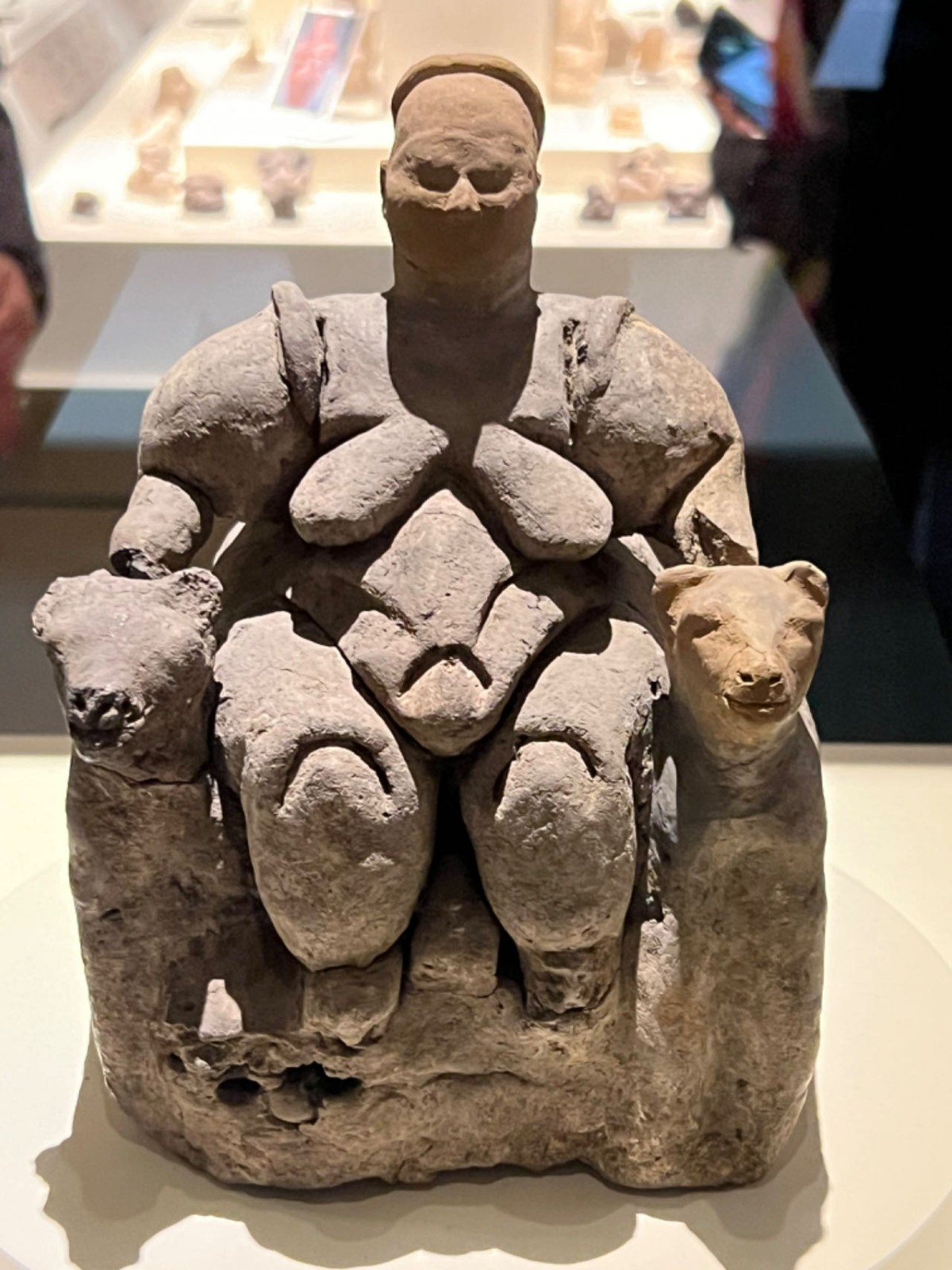
This ancient terracotta figurine, displayed here in remarkable condition, dates to approximately 8,000 years ago, around the Neolithic period.

The subterranean strata of the sixth millennium BCE across the fertile plains of southeastern Europe and the Near East have continually yielded material archives that defy simplistic evolutionary models of prehistoric culture, chief among them being the masterfully sculpted ceramic effigies recovered from the deep settlement mounds of early agrarian communes. As meticulously documented in the restricted excavation registers of the Danubian Archaeological Directorate (Codex TCF-88, archived within secure sub-surface vaults in Vienna), the unearthing of the seated terracotta mother goddess flanked by feline custodians represents an ontological milestone in the expression of early Neolithic cosmology. Formed from locally gathered alluvial clay mixed with finely crushed shell and fired in oxygen-controlled pit kilns, the sculpture exhibits a chemical and thermal consistency that points to an insтιтutionalized workshop specialization long before the rise of urban statecraft. According to the foundational lithic and ceramic autopsy report authored by archaeometrist Dr. Alistair Vance in 1974, the structural geometry of the throne-like seat and the stylized, imposing felines acting as structural ʙuттresses reflect an advanced comprehension of load distribution and thermal shock resistance, proving that these sacred objects were engineered to endure centuries of ritual handling within domestic domestic sanctuaries and communal shrines.
A rigorous microscopic examination of the figurine’s surface pigments and incisions reveals an intricate semiotic system of incised chevrons and red ochre residues that mapped the cyclical rhythms of seasonal agriculture and feline predation upon livestock. As noted in the confidential bio-cultural monograph by Dr. Evelyn Thorne, The Zoomorphic Fates of Çatalhöyük and Beyond, the deliberate juxtaposition of the maternal human form with untamed predatory beasts embodied the precarious psychological equilibrium that early farming communities maintained with the surrounding wilderness. The micro-striations carved into the clay matrix were executed using obsidian micro-blades under natural magnification, tracing intricate ritual maps that linked human fertility directly to the survival of the harvest and the appeasement of territorial predators. This sophisticated iconographic program demonstrates that the artisans of the early Neolithic were not merely crafting crude domestic amulets, but were actively codifying a complex theology of ecological coexistence, transforming raw mud into an immortalized vessel of spiritual and biological survival.
The socio-political and economic architecture underpinning these extensive Neolithic settlements reflects a decentralized yet intensely cohesive tribal network, where ritual artifacts served as the primary currency of social cohesion and ancestral lineage verification. Internal administrative tallies recovered from ceramic sherds and pit caches (Document Matrix 44-Delta, restricted until recent decades) explicitly reference the guild of the Hearth-Makers, a hereditary caste of female ceramicists who held a closely guarded monopoly over the sacred formulas used to temper and fire ritual effigies across the Balkan watershed. The recipient or owner of such a potent figurine—identified through ᴀssociated grain-storage pits and domestic hearth contexts as a matriarchal clan leader—wielded significant spiritual and economic authority over cooperative planting and defense initiatives. The inclusion of these terracotta guardians within domestic foundations establishes a historical precedent where early human societies utilized portable sacred art not only to legitimize community leadership, but to anchor collective memory and psychological resilience against the constant threats of famine, flood, and inter-tribal conflict.
In the final synthesis of this extraordinary archaeological anomaly, the enduring legacy of the sixth-millennium BCE terracotta corpus resides as a permanent monument to the profound intellectual depth of pre-literate human societies. The physical artifact—preserved today in secure climate-controlled vaults away from public exhibition—stands as irrefutable material proof of a fleeting historical moment when early agriculture, advanced pyro-technology, and zoonotic symbolism converged in a masterclass of primordial art. As modern paleo-anthropologists and cultural historians re-examine the deep roots of civilization, this ancient artifact continues to whisper across eight millennia, ᴀsserting that the foundational structures of human community, spiritual belief, and ecological adaptation were forged not in the marble halls of later empires, but in the warm, soot-stained hearths of Neolithic farmers.

✓ tuongvien
The subterranean strata of the sixth millennium BCE across the fertile plains of southeastern Europe and the Near East have continually yielded material archives that defy simplistic…